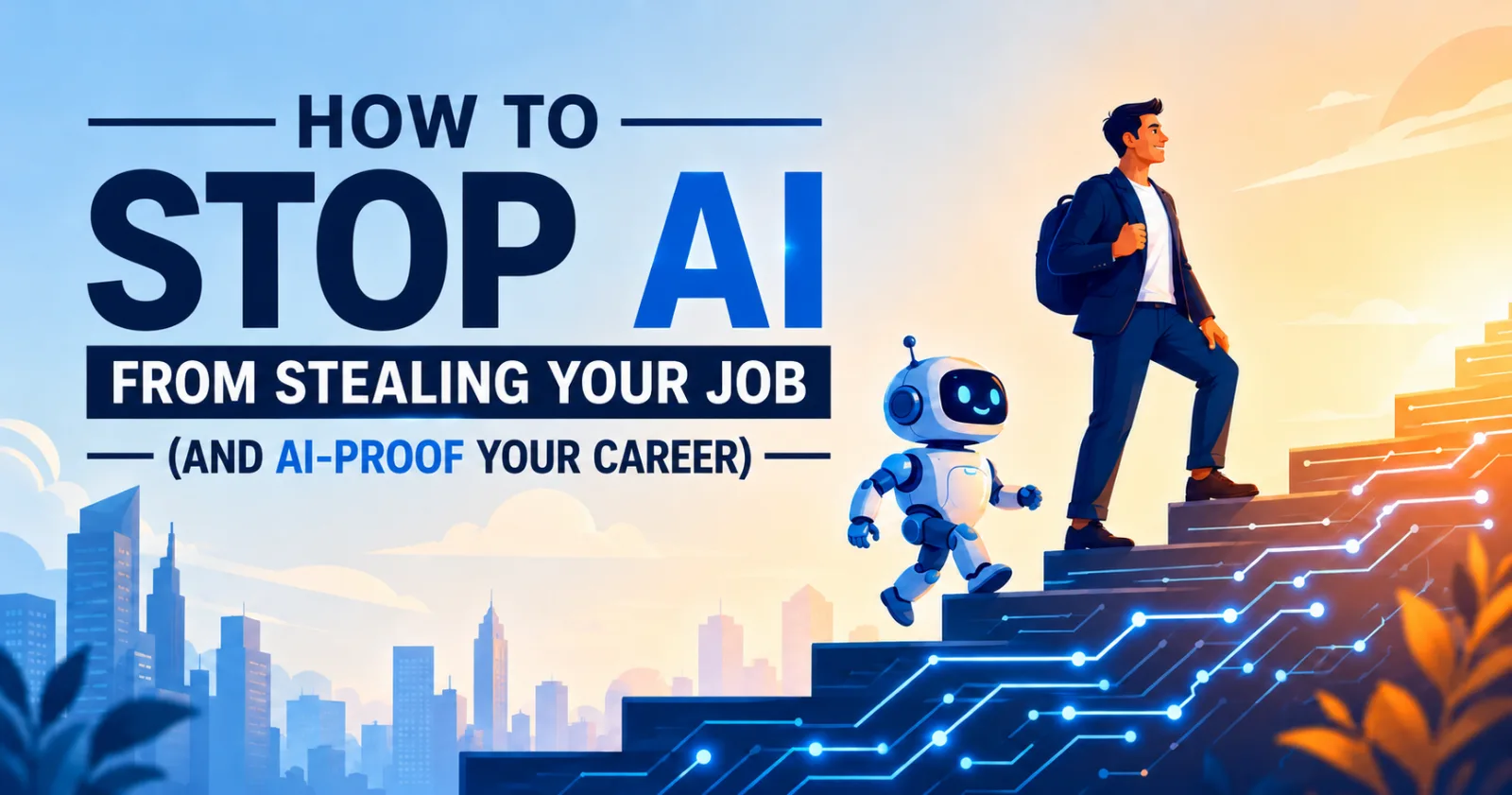
How to Stop AI From Stealing Your Job (And AI-Proof Your Career)
Worried AI will take your job? Here's how to stop AI from stealing your job with 7 simple steps you can start using today.
Read in
Quick Answer: Here's how to stop AI from stealing your job: focus on skills machines still can't do well — judgment, people skills, and creative problem-solving. Learn to use AI tools instead of competing with them, keep learning new skills every few months, and stay visible at work. That combination is still the strongest job security you can build in 2026.
Ever open your phone and see another headline about AI replacing workers? If you're trying to figure out how to stop AI from stealing your job, you're not alone — and the good news is, it's more in your control than it feels.
Here's the truth: some jobs really are changing fast because of AI. But most people aren't losing their jobs to AI itself. They're losing them to people who learned how to use AI better and faster.
That's actually good news. It means how to stop AI from stealing your job isn't about fighting the technology. It's about staying one step ahead of it. Stick with this guide, and you'll walk away with a clear, simple plan you can start today.
What Does "AI Taking Your Job" Actually Mean?
In-content ad slot300 × 250 / responsive
AI taking your job doesn't usually mean a robot walks in and replaces you overnight. It's slower and quieter than that.
Companies start using AI tools to do parts of a task — writing a first draft, sorting data, answering simple customer questions. Over time, they need fewer people to finish the same amount of work.
So the real risk isn't "AI vs. you." It's "you without AI skills vs. someone with them." That's the shift you need to understand before you can protect yourself from it.
Why You Need a Plan to AI-Proof Your Job
You might think this doesn't apply to you yet. But waiting until it feels urgent is exactly how people get caught off guard.
Here's why building a plan now matters:
• AI adoption is speeding up. Companies are rolling out AI tools faster than most workers can keep up with on their own.
• Job descriptions are quietly changing. Roles that used to be "manual" now expect some comfort with AI tools.
• Skills gaps show up fast in layoffs. When companies cut costs, they usually keep the people who can do more with less.
• Confidence matters. Knowing you have a plan takes away a lot of that background anxiety about the future.
• Early movers get better opportunities. The people who adapt first usually get picked for new projects, promotions, and raises.
You don't need to panic. You just need to start.
How to Stop AI From Stealing Your Job: 7 Simple Steps
This isn't about becoming a computer expert overnight. It's about building habits that keep you valuable, no matter how fast AI moves.
Step 1: Figure Out Which Parts of Your Job AI Can Actually Do
Sit down and list your daily tasks. Be honest about which ones are repetitive, rule-based, or pattern-driven — those are the ones AI tools handle well.
This isn't about scaring yourself. It's about seeing clearly so you know exactly where to focus your energy next.
Step 2: Learn the AI Tools Used in Your Industry
You don't have to learn every AI tool out there. Just learn the two or three that show up most in your field.
Spend 20 to 30 minutes a few times a week trying them out. Small, steady practice beats one long study session every time.
Step 3: Double Down on Skills AI Still Struggles With
AI is still weak at reading a room, handling tricky conversations, and making judgment calls with incomplete information. Lean into those.
Things like leadership, negotiation, mentoring, and creative strategy are still deeply human. Practice them on purpose, not just when they happen to come up.
Step 4: Turn Yourself Into the "AI Plus Human" Option
Instead of trying to out-work AI, use it to work faster, then add your own judgment on top. That combination is hard to replace.
For example, use AI to draft a report, then use your experience to catch what it missed. That extra layer is your real value.
Step 5: Keep a Running List of Your Wins
Write down projects you improved, problems you solved, and results you drove — with numbers where you can. This becomes your proof of value.
When review time or a layoff round comes around, you want facts ready, not just a vague feeling that you work hard.
Step 6: Build Skills Outside Your Current Job Too
Cross-train in something adjacent to your role. If you're in marketing, learn basic data skills. If you're in support, learn a bit about product strategy.
This gives you options if your specific role ever gets automated or restructured.
Step 7: Stay Visible and Keep Learning in Public
Share what you're learning with your manager or team. Ask to be part of AI pilot projects at work instead of avoiding them.
If you're looking for more practical, no-fluff career guides like this one, you can always check the [latest career and tech guides on Blogslet] for fresh tips as things change.
Real Benefits of Learning How to Stop AI From Stealing Your Job
Building this plan isn't just about survival. It actually improves your day-to-day work life.
• Less anxiety about the future, because you have a clear plan instead of just worry.
• Higher pay potential, since AI-skilled workers are already earning more in many roles.
• More interesting work, because AI can take the boring, repetitive tasks off your plate.
• Stronger resume, with real proof you can adapt and grow.
• Better job options, since companies actively want people who "get" AI.
• More confidence, walking into performance reviews and interviews.
Common Mistakes People Make (And How to Fix Them)
Most people don't fail because they're lazy. They fail because they focus on the wrong things.
Mistake 1: Ignoring AI Completely
Pretending AI won't affect your job doesn't slow it down. It just leaves you unprepared when changes finally hit.
Fix: Spend even 15 minutes a week learning about AI tools in your field.
Mistake 2: Trying to Learn Everything at Once
Jumping between ten different AI tools burns you out fast, and you end up mastering none of them.
Fix: Pick two tools, get good at them, then expand from there.
Mistake 3: Only Focusing on Technical Skills
Some people learn every AI tool but forget the human skills that make them valuable in the first place.
Fix: Balance tool skills with communication, leadership, and problem-solving practice.
Mistake 4: Staying Silent About What You're Learning
If your manager doesn't know you're upskilling, it won't help you when decisions get made.
Fix: Mention your progress naturally in check-ins, emails, or team meetings.
AI-Resistant Skills vs. AI-Vulnerable Skills
Skill Type
AI-Resistant Skills
AI-Vulnerable Skills
Thinking
Judgment, strategy, decision-making
Repetitive data sorting
People
Leadership, negotiation, mentoring
Scripted customer replies
Creative
Original ideas, storytelling, design direction
Basic content formatting
Technical
Using AI tools skillfully
Simple, rule-based coding tasks
Pro Tips to Stay Ahead of AI at Work
• Set a monthly "skills check-in" with yourself to see what's changing in your field.
• Follow two or three trusted industry newsletters, not fifty random ones.
• Ask AI to explain its own limits in your field — it's often surprisingly honest about this.
• Volunteer for AI-related projects at work, even small ones.
• Practice explaining your value in one sentence, so you're ready for reviews or interviews.
• Save examples of your judgment calls, not just finished tasks — that's what AI struggles to copy.
Why Blogslet Is a Good Place to Keep Learning About This
Staying ahead of AI at work isn't a one-time fix. It's an ongoing habit, and having a reliable place to check in helps.
Blogslet breaks down tech and career topics in plain, simple language, without the hype or scare tactics. Every guide is written to actually help you take action, not just make you worried and leave you there.
If you want more clear, practical reads like this one, it's worth bookmarking and checking back often.
Frequently Asked Questions
Will AI really take over most jobs by 2026?
No. AI is changing how many jobs get done, but most roles still need human judgment, communication, and decision-making. The bigger risk is falling behind on AI skills, not the technology itself replacing you outright.
What jobs are the safest from AI?
Jobs built around leadership, hands-on care, complex judgment calls, and creative direction tend to be safer. Think managers, therapists, skilled trades, and senior strategists — roles where people, not patterns, drive the outcome.
How long does it take to AI-proof your career?
There's no fixed timeline, but most people see real progress within three to six months of steady, small effort. The key is consistency, not speed — 20 minutes a few times a week adds up fast.
Do I need to learn to code to stay safe from AI?
No, coding isn't required for most roles. Learning to use AI tools well, plus strengthening your people and judgment skills, matters far more for most careers than becoming a programmer.
Is it too late to start learning AI skills?
It's almost never too late. Companies are still in the early stages of adopting AI well, so workers who start now are still ahead of a large chunk of the workforce.
Can AI actually help me keep my job instead of losing it?
Yes. Workers who use AI to work faster and smarter often become more valuable, not less. The goal isn't avoiding AI — it's learning to work alongside it so you stand out.
Final Thoughts: You Have More Control Than It Feels Like
AI isn't going away, and pretending otherwise won't help you. But you now have a clear, simple plan for how to stop AI from stealing your job — one small step at a time.
Start with just one step from this guide today, even a small one. For more honest, easy-to-follow guides on tech and career topics, keep Blogslet on your list — it's built to help you stay ready, not stressed.
You've got more time and more control here than the headlines make it feel like. Use it.
Keep reading